
Natural Refrigerants in Thermostats: Importance, Selection, and Safe Use
Natural refrigerants are becoming increasingly important in temperature control technology. International regulations are reducing the use of fluorinated refrigerants with high GWP values. As a result, propane and carbon dioxide are coming into particular focus for thermostats and cooling systems. It is crucial to select the refrigerant that is appropriate for the application, the temperature range, and the installation conditions.
What are refrigerants?
Refrigerants are working fluids within a refrigeration system. Their function is to absorb heat at one point and release it at another. In this way, heat can be removed from an area that needs to be cooled. Depending on the application, natural refrigerants such as R-290 (propane) or R-744 (CO₂) (carbon dioxide) as well as synthetic refrigerants are used.
The requirements a refrigerant must meet depend, among other things, on the required temperature range, cooling capacity, energy efficiency, installation location, and applicable safety requirements. Therefore, there is no single refrigerant that is suitable for all applications.
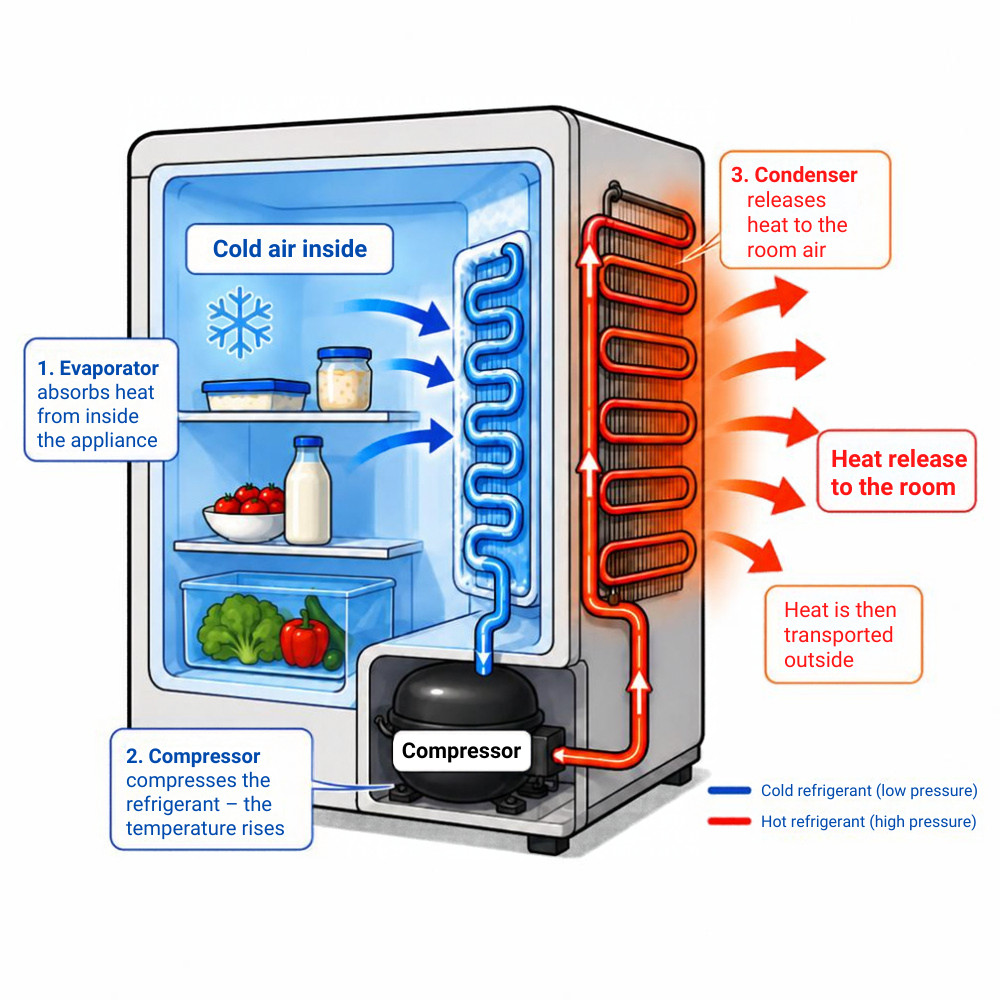
Everyday example: How does the refrigerant work in a refrigerator?
A refrigerator removes heat from its interior and releases it into the surrounding environment. The refrigerant is responsible for transporting heat within the closed refrigeration system: it absorbs heat from the interior and releases it outside the refrigerator. This lowers the temperature inside the refrigerator or maintains it at the set level.
This simplified example illustrates the basic function of a refrigerant: It does not generate cold on its own, but rather enables heat to be transferred in a targeted manner from one area to another.
Application Example: What Happens in a Thermostat?
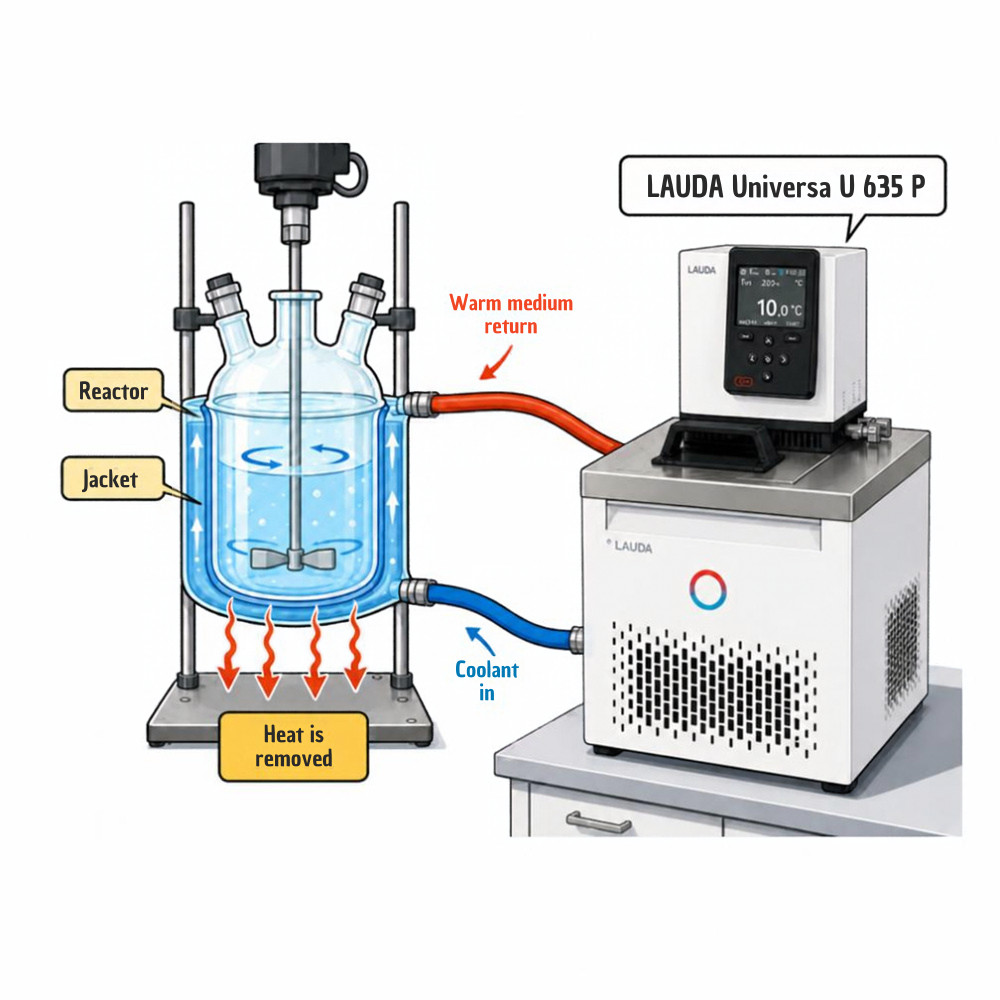
A thermostat maintains an application at a defined setpoint. If the application needs to be cooled, the refrigeration system absorbs heat from the application and dissipates it. If the temperature needs to be raised, the thermostat’s heating element provides the heat. This allows the device to regulate the temperature and stabilize it even when the setpoint changes.
In the case of a process thermostat, for example, this may mean that a connected process generates heat. The temperature control unit continuously dissipates this heat until the desired setpoint is reached. If the heat load or the setpoint changes, the unit adjusts its heating or cooling capacity accordingly. The refrigerant is the working fluid of the refrigeration system that enables the necessary heat transfer.
The thermostat example also illustrates why the choice of refrigerant must be tailored to the specific application: the temperature range, required cooling capacity, energy efficiency, and installation conditions determine which technical solution is appropriate.
Why is refrigeration technology changing?
The European Union’s F-Gas Regulation and other international regulations call for a phased reduction of fluorinated refrigerants with high GWP equivalents. This so-called “phase-down” limits the cumulative amount of CO₂ equivalents that may be placed on the market as F-gases. As a result, refrigerants with high GWP values are becoming less available and are continuously increasing in price.
The Montreal Protocol, with its Kigali Amendment, also requires countries worldwide to continuously reduce the use of fluorinated refrigerants in both production and consumption. This is implemented through various phase-down curves and timelines.
What does the GWP value mean?
The GWP value (Global Warming Potential) describes a gas’s contribution to global warming as a CO₂ equivalent. For example, a GWP of 5 means that 1 kg of the refrigerant in question is equivalent to an emission of 5 kg of CO₂.
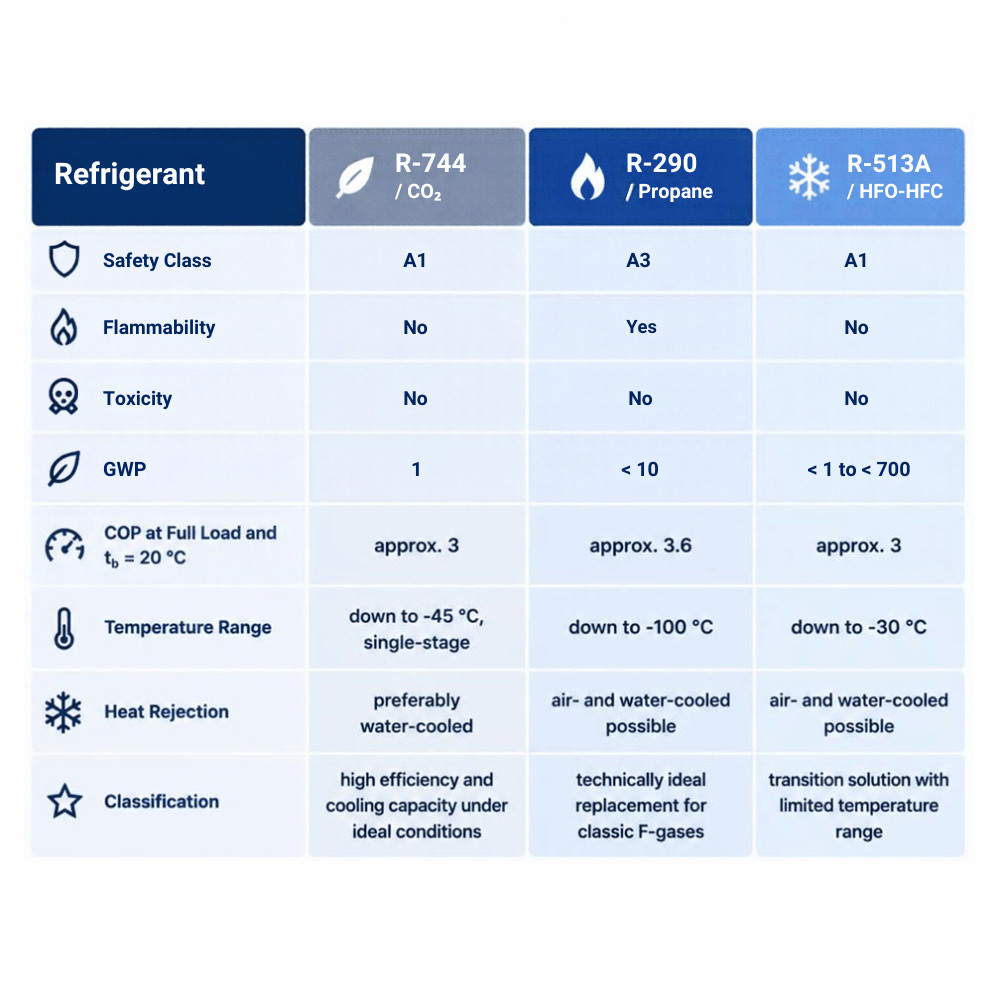
Many natural refrigerants, such as CO₂, propane, and ethane, have GWP values below 10. New types of fluorinated refrigerants, known as HFOs, have GWP values significantly lower than those of traditional HFC refrigerants and can serve as a transitional solution in certain applications.
What natural refrigerants are used in thermostats?
The LAUDA guide specifically highlights R-290 (propane) and R-744 (CO₂) as natural refrigerants for temperature control units and cooling systems.
R-290 (propane): a versatile refrigerant
R-290 (propane) is the official designation for propane as a refrigerant. It has no ozone depletion potential and a GWP value of 3. LAUDA describes R-290 (propane) as an important refrigerant due to its versatility, high performance, and robustness.
R-290 (propane) is suitable for indoor and outdoor installation, as well as for air- or water-cooled systems. It achieves high energy efficiency even at supply temperatures above 0 °C. The guide identifies R-290 (propane) and other A3 refrigerants as approximate 1-to-1 replacements for fluorinated refrigerants. Comparable properties also apply to other natural hydrocarbons such as R-170 (ethane) or R-1270 (propene).
R-744 (CO₂): Carbon dioxide for high cooling capacity
R-744 (CO₂) is the official designation for carbon dioxide as a refrigerant. It occurs naturally, is nonflammable, and has no harmful effects on the ozone layer. Its GWP is 1.
Due to higher operating pressures, R-744 (CO₂) requires specialized components and safety measures. According to the guidelines, its strengths lie particularly in applications with high cooling capacity requirements, indoor installation, supply temperatures below 0 °C, and the use of a central cooling water supply.
A Comparison of Natural and Synthetic Refrigerants
The choice of refrigerant affects the temperature range, energy efficiency, unit size, safety requirements, and installation conditions. The following overview summarizes the information provided in the LAUDA guide.
Safety Precautions for Flammable Refrigerants
R-290 (propane) belongs to safety class A3 and is flammable. For LAUDA units containing more than 150 g of A3 or A2L refrigerant, the guide describes an integrated safety concept. A gas detection sensor, integrated as standard, continuously monitors the space within the refrigeration system for potential gas leaks.
The unit may only be turned on if the test results are normal. If refrigerant is detected during operation, a warning is issued initially, depending on the concentration. If the concentration continues to rise, the components are safely disconnected from the power supply.
Integral units containing more than 150 g of R-744 (CO₂) or A3 refrigerant are additionally equipped with a quick-stop switch and an interface for integration into a central emergency shutdown system. According to the guidelines, the units can be used without additional retrofitting, provided the minimum room size requirements are met.
What are the requirements for the installation site?
Units using A3 and A2L refrigerants can be installed and operated in accordance with the prescribed minimum room size requirements, thanks to their built-in safety sensors. For refrigerant charges of 150 g or more, minimum room volumes at the installation site, as well as gas detection sensors and ventilation where applicable, may be required.
For equipment using CO₂, it is particularly important—especially when installed underground or in above-ground rooms without emergency exits—to carefully assess the installation conditions and the ventilation plan in order to prevent oxygen depletion in the installation room.
The required minimum room volume is calculated based on the specific room volume per kilogram of refrigerant and the amount of refrigerant used. The specific values can be found in the respective data sheet. If multiple temperature control units are operated in a single room, the guidelines state that only the unit with the highest space volume requirement should be taken into account; the values are not added together.
Energy Efficiency: It’s Not Just the Refrigerant That Matters
LAUDA points out that approximately 95% of CO₂ emissions over the lifetime of a unit occur during operation. For this reason, refrigeration systems are designed with electronic controls and variable-speed compressor technology whenever possible.
The COP (Coefficient of Performance) describes the ratio of cooling capacity to electrical power input. It is useful for comparing chillers at a defined, static setpoint. However, process thermostats often operate dynamically with changing setpoints. Therefore, a reliable evaluation requires consideration of the specific application scenario.
CO₂ systems operate at high performance and efficiency levels at low ambient and cooling water temperatures. According to the guidelines, efficiency decreases significantly if the cooling water temperature exceeds 20 °C. A3 refrigerants, such as propane, behave similarly to conventional F-gases and remain powerful and efficient even at a cooling water temperature of 30 °C or an ambient temperature of 40 °C.
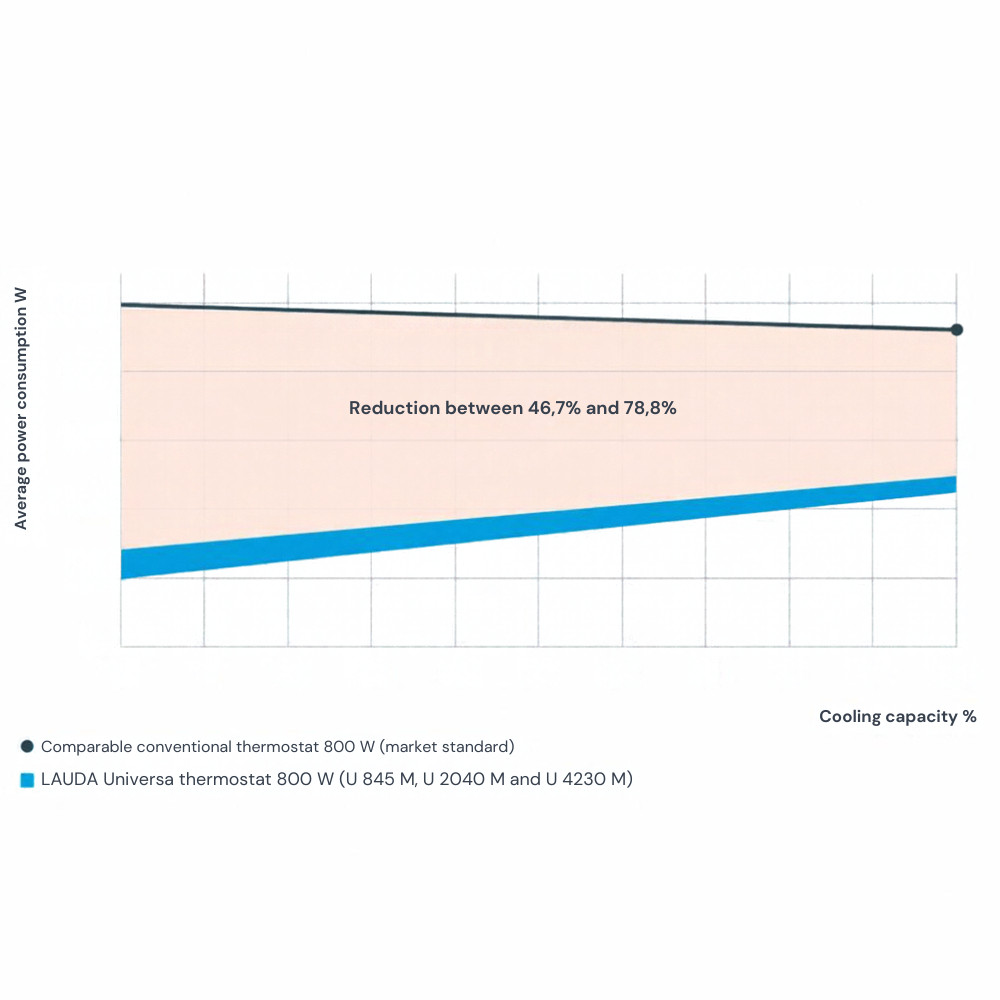
Since applications and cooling processes operate in the partial-load range for a large portion of the time, speed-controlled compressors offer significant savings potential. The guide states that the LAUDA Ultracool achieves energy savings of up to 50% compared to conventional systems without inverter technology and variable-speed control, and that the LAUDA Universa achieves savings of up to 78%.
Which LAUDA thermostats use natural refrigerants?
The guide lists various equipment lines that use natural refrigerants. Gas detection capabilities and airworthiness vary depending on the equipment, refrigerant quantity, and safety class.
- Alpha and Universa Bath Thermostats: A3 refrigerant, less than 100 g, no gas sensors required, airworthy.
- Microcool Circulating Cooler: A3 refrigerant, less than 100 g, no gas sensors required, airworthy.
- Ultracool UC 2 through UC 100 Circulating Coolers: A3 refrigerant, more than 150 g, equipped with gas sensors, not airworthy.
- Integral IN 1040, 2540, and 3540 XTW Process Thermostats: R-744 (CO₂), more than 150 g, no gas sensors required, airworthy.
- Integral IN 550, 750, 950, and 1850 XT/XTW Process Thermostats: A3 refrigerant, more than 150 g, gas sensors included, not airworthy.
- PRO Process Thermostats: A3 refrigerant, less than 150 g, no gas sensors required, not airworthy.
- Variocool VC 1200 and 2000: A3 refrigerant, less than 100 g, no gas sensors required, airworthy.
- Variocool VC 5000 and 10000 in EU versions with 50 Hz: A3 refrigerant, more than 150 g, gas sensors included, not airworthy.
Transportation and Logistics
LAUDA devices containing flammable refrigerants are classified under UN number UN 3358. Air transport is governed by IATA regulations. Devices containing less than 100 g of gas are not considered dangerous goods under the regulation, in accordance with Special Provision A103 as specified in the guidelines.
For devices containing more than 100 g of flammable Class A3 and A2L refrigerants, LAUDA offers special logistics and service processes for expedited air freight shipments. Local regulations may stipulate stricter limits or additional requirements.
Natural refrigerants enable a significant reduction in global warming potential in temperature control technology. R-290 (propane) offers broad applicability, high performance, and temperature ranges down to -100 °C. R-744 (CO₂) is non-flammable and is particularly well-suited for high cooling capacities, low flow temperatures, and water-cooled indoor installations. The appropriate solution depends on the application, temperature range, capacity requirements, energy efficiency, installation location, and safety requirements.
To ensure safe and efficient operation, refrigerants, equipment configuration, and installation conditions must be considered together.
Are you looking for a high-performance temperature control solution that uses natural refrigerants? With LAUDA Universa, IGZ Instruments offers state-of-the-art cooling thermostats for precise, energy-efficient, and reliable temperature control tasks—tailored to your specific needs in laboratories, research, and industry. Please feel free to contact us, and we’ll be happy to advise you personally.