
Polarimetry: Definition, Measurement Principle, and Importance for the Pharmaceutical, Chemical, and Food Industries
Polarimetry is an analytical method for studying optically active substances. It determines the extent to which a sample rotates the plane of polarization of linearly polarized light. This provides information about the substance, its concentration, purity, and molecular structure.
What is polarimetry?
A polarimeter determines the direction of polarization of light and the optical rotation of optically active substances. These substances include, among others, sugars, amino acids, and other chiral molecules. For this reason, polarimetry is used in chemistry, pharmacy, food analysis, and biochemistry.
When taking measurements, a distinction is made between two quantities:
- Angle of rotation: the directly measured value representing the rotation of the plane of polarization.
- Specific rotation: a value that also takes into account the concentration of the sample and the length of the measuring tube.
How does a polarimeter work?
Linearly polarized light passes through a liquid, optically active sample. The sample rotates the plane of polarization by a specific angle. The polarimeter detects this change. The measured angle of rotation provides information about the substance being analyzed.
KRÜSS cites sucrose and fructose as examples: Sucrose rotates the plane of polarization clockwise, while fructose rotates it counterclockwise. This allows the two substances to be distinguished from one another.
Why is polarimetry important?
The angle of rotation can provide information about the molecular structure, purity, and concentration of an optically active substance. The measurement is performed without chemically altering or destroying the sample.
Typical applications include:
- Quality Control in the Manufacture of Active Pharmaceutical Ingredients
- Identity Testing of Chiral Substances in the Incoming and Outgoing Goods Laboratories
- Determination of Concentration and Purity in the Food, Starch, and Sugar Industries
- Analytical Tasks in Chemistry, Pharmacy, Food Analysis, and Biochemistry
Practical Example: Testing Chiral Drugs Using Ibuprofen as an Example
A typical application of polarimetry in pharmaceutical analysis is the study of chiral drugs. A good example is ibuprofen.
The active ingredient exists in two mirror-image forms, known as enantiomers: R-ibuprofen and S-ibuprofen. Although both molecules have very similar chemical structures, they differ in their spatial structure. In ibuprofen, the S-enantiomer is pharmacologically active.
Polarimetry takes advantage of precisely this spatial structure. Enantiomers rotate the plane of polarization of linearly polarized light in different directions. After enantiomer separation, the optical rotation of the resulting sample can therefore be measured. The measured angle of rotation provides information on whether the sample under investigation exhibits the expected optical properties, thereby supporting the monitoring of enantiomer separation and the quality control of the active pharmaceutical ingredient.
To perform the measurement, the liquid sample is placed in a polarimeter cuvette and illuminated with polarized light. The polarimeter measures the angle by which the plane of polarization is rotated by the sample. Since the angle of rotation depends, among other things, on the concentration, the optical path length, the wavelength, and the temperature, these factors must be controlled to ensure reproducible measurements.
With the P9100-P, the integrated Peltier temperature control system maintains a controlled temperature for the sample. This helps ensure stable measurement conditions and reduces temperature-related deviations in the angle of rotation.
Note: This practical example is based on a customer application described by IGZ.
The P9000 Series from A. KRÜSS Optronic
The P9000 series instruments are digital polarimeters designed to measure the optical rotation, specific rotation, or concentration of liquid, optically active samples. The optical sensor, temperature control system, measurement and evaluation electronics, and touchscreen display are all integrated into the instrument.
According to KRÜSS, the devices, including their firmware, meet the requirements for FDA-regulated areas as well as for the European Pharmacopoeia (EP / Ph. Eur.), the U.S. Pharmacopeia (USP), the British Pharmacopoeia (BP), and the Japanese Pharmacopoeia (JP). KRÜSS also cites regulatory requirements such as 21 CFR Part 11 and EU Annex 11.

Reliable Measurement Results Thanks to Assistance Systems
Correct filling, stable temperature conditions, and consistent measurement values are crucial for precise and reproducible results. The P9000 series supports these steps with several assistance systems.
Sample Loading and Sample Cell Check
- Monitoring the sample during filling
- Detection of air bubbles, inhomogeneities, streaks, and particles
- Filling the measuring cell directly in the temperature-controlled measuring device
- For the P9200-P and P9300-P: Sample Cell Check with Camera
Temperature Control with TempGate
- Continuous monitoring of sample temperature and the measuring device
- Sample temperature control with an accuracy of up to ±0.1 °C
- LED light bar to indicate that the device is ready for measurement
- Avoiding Temperature Gradients in the Sample and the Measuring Device
Monitoring Measurement Stability
- Continuous monitoring of measurement stability during the measurement
- Ongoing Analysis of Preliminary Measurements
- A measured value is saved in the results memory only if the stability criteria are met.
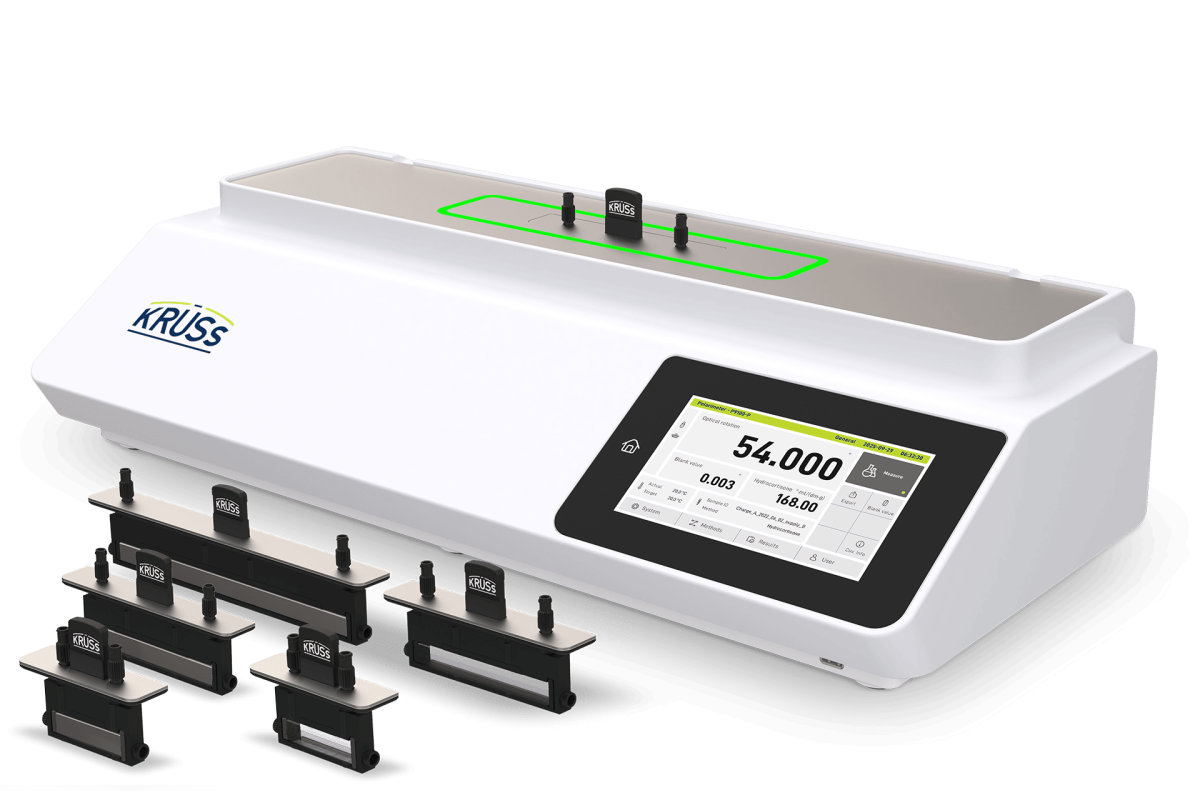
Polarimeter Cells and Sample Volumes
The rectangular glass cuvettes of the P9000 series allow for visual inspection along the entire length of the cuvette. This makes it possible to detect air bubbles, particles, and streaks. The cuvette is heated via its side walls to ensure uniform temperature distribution.
For measurements using the 100-mm-long cuvette, KRÜSS specifies a minimum sample volume of 1.3 mL. The cuvette can be filled with a syringe either directly inside the temperature-controlled polarimeter or outside the instrument.
Cuvettes equipped with RFID are automatically detected. The device records relevant cuvette data such as length, material, and temperature control parameters.
Polarimetry enables the analysis of liquid, optically active samples based on their angle of rotation. It is used, among other things, to determine concentration and purity, as well as for identity and quality control. With integrated Peltier temperature control, assistance systems for sample and measurement value monitoring, and features for regulated working environments, the P9000 series is designed for demanding measurement tasks in laboratories and quality control.
Has this sparked your interest in polarimetry?
We would be happy to assist you in selecting the right solution for your measurement tasks. We will work with you to analyze your requirements and advise you on choosing the appropriate polarimeter for your application in the lab, quality control, or production.
Please feel free to contact us for a personalized consultation or a customized solution for your application.
FAQ on Polarimetry
What is polarimetry?
Polarimetry is an analytical measurement method used to determine the optical activity of substances. It measures the extent to which an optically active sample rotates the plane of polarization of linearly polarized light. The measured rotation provides information about the substance’s properties, such as concentration, purity, and composition.
What does a polarimeter measure?
A polarimeter measures the angle of optical rotation of a sample. This angle describes the amount by which an optically active substance rotates the plane of polarization of light. The measured value can be used to determine, among other things, the concentration, purity, or identity of a substance.
How does a polarimeter work?
A polarimeter generates linearly polarized light, which is passed through a sample containing optically active molecules. These molecules rotate the plane of polarization of the light. The device measures the angle of rotation and uses it to calculate the sample’s measurement value.
Which substances can be analyzed using polarimetry?
Polarimetry can be used to measure optically active substances. These include, among others, sugars such as sucrose and fructose, amino acids, chiral active ingredients, and other molecules with an asymmetric structure. The method is therefore frequently used in the pharmaceutical industry, food analysis, chemistry, and biochemistry.
What is the difference between the optical rotation angle and the specific rotation angle?
The optical rotation angle is the directly measured angle by which a sample rotates the plane of polarization of light. The specific rotation angle additionally takes into account factors such as concentration, measurement length, and temperature. This allows for better comparison of measurement values from different samples.
Why is temperature important in polarimetric measurements?
Temperature affects the optical rotation of many substances. Even small temperature differences can alter the measurement results. For this reason, modern polarimeters are equipped with precise temperature control—such as integrated Peltier systems—to ensure reproducible measurements.
What are the applications of polarimetry in the pharmaceutical industry?
In the pharmaceutical industry, polarimetry is used, among other things, for identity testing, quality control, and determining the concentration of optically active ingredients. Especially in the case of chiral substances, this measurement can provide additional information about composition and purity.
What is the significance of polarimetry in the food industry?
In food analysis, polarimetry is frequently used to determine sugar and carbohydrate concentrations. Typical applications include, for example, the sugar and starch industries, as well as quality control in the food and beverage sectors.
What are optically active substances?
Optically active substances are molecules that can rotate the plane of linearly polarized light. This is often due to a chiral molecular structure, in which a molecule is not identical to its mirror image. Examples include many sugars, amino acids, and active pharmaceutical ingredients.
Why is polarimetry used for quality control?
Polarimetry enables fast, non-destructive measurements without chemically altering the sample. This makes the method particularly suitable for routine testing, incoming goods inspections, and the monitoring of production processes.
What factors can affect the accuracy of a polarimeter measurement?
The accuracy of a polarimetric measurement depends, among other things, on the following factors:
- Temperature of the sample
- Concentration of the solution
- Length and Quality of the Measuring Cell
- Air bubbles or particles in the sample
- Purity and Homogeneity of the Test Solution
Modern polarimeters help users avoid measurement errors through automatic stability checks and assistance systems.
What advantages does polarimetry offer over other analytical methods?
Polarimetry is a fast, non-destructive, and relatively simple analytical method. It often requires only small sample sizes and is particularly well-suited for routine testing of optically active liquids.
What role does the KRÜSS P9000 series play in polarimetric measurements?
The KRÜSS P9000 series supports precise polarimetric measurements with features such as integrated Peltier temperature control, automatic cuvette recognition, Sample Cell Check, and measurement stability verification. This makes it particularly well-suited for applications in laboratories with high standards for accuracy and documentation.
What standards and regulatory requirements apply to polarimeters in the pharmaceutical industry?
In regulated pharmaceutical sectors, requirements from pharmacopoeias such as the European Pharmacopoeia (Ph. Eur.) and the U.S. Pharmacopeia (USP), as well as regulations such as 21 CFR Part 11 and EU Annex 11, play a role. These pertain, among other things, to data integrity, documentation, and electronic records.
Source base
This article was prepared solely on the basis of the following websites and the customer example provided by IGZ:
- https://www.kruess.com/produkte/polarimeter/polarimeter-p9000-p-mit-peltier-temperierung/
- https://www.kruess.com/campus/polarimetrie/
- https://igz.ch/news/wasseraktivitaet-aw-definition-messung-und-bedeutung-fuer-lebensmittel-pharma-und-kosmetik/