
Diabetology: Modern Diagnostics, HbA1c Measurement, and Monitoring Devices
Diabetology focuses on the prevention, diagnosis, and treatment of diabetes mellitus and its complications. Reliable diagnostics form an important foundation of modern diabetes care. Measurements such as blood glucose and HbA1c help
healthcare professionals assess patients’ metabolic status and monitor the progression of diabetes. Modern diabetes monitoring devices and point-of-care analyzers make it possible to perform certain tests directly in a doctor’s office,
diabetes clinic, or medical facility. This ensures that diagnostic information is available quickly.
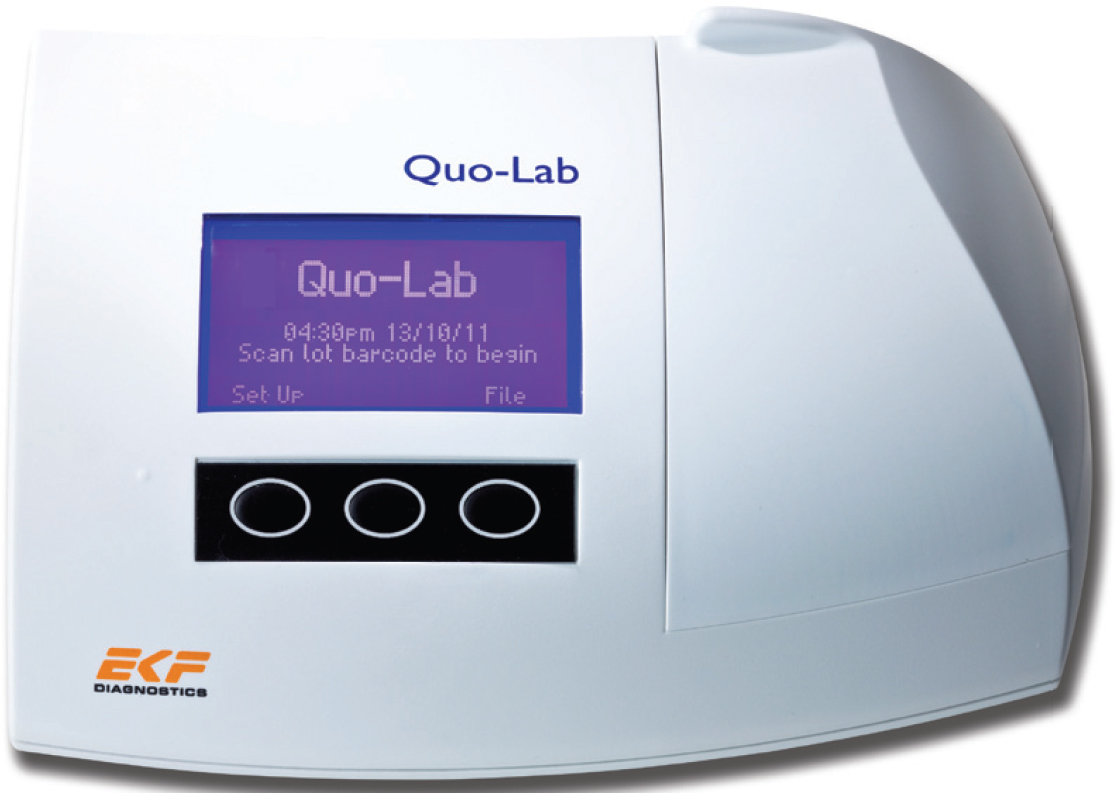
IGZ Instruments offers solutions from EKF Diagnostics, among others, for diabetes diagnostics in Switzerland. One of its key products is the Quo-Lab HbA1c meter, a compact point-of-care analyzer for rapid and reliable HbA1c measurement.
What is diabetology?
Diabetology is a medical specialty that focuses on diabetes mellitus and related metabolic disorders.
The most common types of diabetes include, among others:
- Type 1 Diabetes
- Type 2 Diabetes
- Gestational Diabetes
- Other specific types of diabetes
Diabetology encompasses more than just the treatment of already diagnosed conditions. Diabetes diagnosis, monitoring, and prevention also play an important role.
Reliable measurement of various laboratory and metabolic parameters is therefore an essential part of medical care.
What is measured in cases of diabetes?
Various measurements
and tests are used in diabetes diagnosis. Among the best-known parameters are blood sugar (glucose) and HbA1c.
While a glucose test provides a snapshot of blood sugar levels, the HbA1c level offers a longer-term view of blood sugar control.
That is why measuring HbA1c is an important part of diabetes diagnosis and management.
This raises the question for medical facilities of how such measurements can be carried out as reliably and efficiently as possible, while also fitting into their respective practice workflows.
What is HbA1c?
HbA1c stands for glycated hemoglobin. This test measures the percentage of hemoglobin that is bound to glucose. The term ” glycated hemoglobin ” is also relevant when searching for information on HbA1c testing.
The HbA1c level is used in diabetes care to assess long-term blood sugar control. Unlike a single blood sugar measurement, the HbA1c level is therefore not just a snapshot.
For physicians, HbA1c testing is relevant, for example, in monitoring the progression of diabetes. Depending on the medical situation, HbA1c levels may also be part of the diagnostic evaluation.
However, measuring HbA1c in a doctor’s office is not only relevant for diagnosis but can also help in adjusting treatment. When the results from a capillary blood sample are available within a few minutes, doctors can discuss the values directly with the patient during the consultation and, if necessary, explain any potential changes to their medication.
Why are blood glucose meters important?
Modern diabetes care requires reliable diagnostic measurements. Diabetes monitoring devices and point-of-care systems can play an important role in this regard.
Point-of-care diagnostics means that a test can be performed directly at the site of medical care.
In the case of HbA1c testing, for example, this could mean that a doctor’s office or diabetes clinic determines the result on-site, rather than sending the sample to an outside laboratory for analysis.
This can be particularly useful when a rapid diagnostic process is desired.
Point-of-Care HbA1c Testing
With point-of-care HbA1c testing, the analysis is performed directly at the medical facility.
For medical practices, diabetes centers, and laboratories, various factors may be relevant:
- How much sample material is needed?
- How quickly are the measurement results available?
- How easy is it to use?
- How much time does the training require?
- How are measurement results stored?
- What options are available for data transmission?
- How can the measuring device be integrated into the existing workflow?
The Quo-Lab from EKF Diagnostics was developed specifically for this type of application as a semi-automatic point-of-care analyzer.
Quo-Lab HbA1c Meter from EKF Diagnostics
With the Quo-Lab HbA1c meter, EKF
Diagnostics offers a solution for professional HbA1c testing.
According to EKF, this compact point-of-care analyzer combines high accuracy—
—with low cost and ease of use. It is
particularly appealing to facilities that wish to perform HbA1c testing directly on-site
.
EKF Diagnostics describes Quo-Lab as a semi-automatic
desktop analyzer for HbA1c measurement. The system was specifically developed for
diabetes clinics and laboratories where ease of use and
low operating costs are important.
How does the HbA1c test work with Quo-Lab?
The Quo-Lab is designed for ease of use.
According to the manufacturer, only 4 µl of blood is needed for the test. The sample can be obtained from a finger prick or a venous blood sample. After completing the prescribed steps, the result is displayed within four minutes.
The process essentially consists of the following:
- Scan the batch’s calibration barcode.
- Prepare the cartridge and load the sample.
- Activate the reagent in the cartridge.
- Insert the cartridge into the analyzer.
- Start the measurement and read the result after about four minutes.
The step-by-step instructions on the display are designed to simplify operation and reduce the amount of training required.
What are the benefits of the Quo-Lab?
The Quo-Lab HbA1c meter is specifically designed for simple HbA1c testing at the point of care.
The features listed by the manufacturer include:
- Only 4 µl of blood per test
- Results within four minutes
- Measurement from fingerstick or venous blood
- semi-automatic analysis method
- multilingual user interface
- Barcode reader for calibration, patient, and operator data
- Storage of up to 7,000 measurement results
- USB interface
- optional label printer
- Compact design measuring 95 × 205 × 135 mm
- Weight of about 0.7 kg
The combination of a small sample volume, short measurement time, and compact design makes the system an attractive option for a variety of point-of-care scenarios.
Another advantage of the measurement is that the result is not affected by
is influenced by hemoglobin variants.
What technology does Quo-Lab use?
Quo-Lab uses a boronate affinity method—or , more specifically, a technology based on boronate affinity—for the
HbA1c assay.
EKF describes the method as Boronate Fluorescence Quenching Technology (BFQT). According to the manufacturer, the method enables rapid HbA1c measurement without chromatographic separation.
The manufacturer specifies a measurement range of 4–15% A1c according to the DCCT and a precision of CV < 3% at 7% A1c for Quo-Lab. The results are traceable to the IFCC reference method.
Who is an HbA1c meter like Quo-Lab suitable for?
A point-of-care HbA1c analyzer may be of particular interest to medical facilities that wish to perform HbA1c tests directly on site.
These include, for example:
- Medical Practices
- Diabetes Clinics
- Diabetes Centers
- Hospitals
- Hospitals
- outpatient medical clinics
- Laboratories
- Medical Diagnostic Facilities
Which solution is suitable for a facility depends, among other things, on the volume of examinations, the desired workflow, and the requirements for data management and quality assurance.
HbA1c Meter for Medical Practices
In a doctor’s office in particular, a rapid HbA1c test can be useful when diagnostic information is needed promptly for further medical evaluation.
The Quo-Lab requires only a small sample volume and, according to the manufacturer, provides a measurement result within four minutes. Its compact design and step-by-step operation are additional features that make it ideal for use directly at the point of care.
This means that an HbA1c analyzer such as Quo-Lab can support an efficient diagnostic process.
Diabetes Diagnostics in Switzerland
In Switzerland, too, efficient and practical medical diagnostics are becoming increasingly important. Medical practices, clinics, hospitals, and medical centers need reliable measurement systems that meet their individual requirements.
IGZ Instruments offers Swiss customers products and solutions for medical diagnostics as well as for other areas in laboratories, research, and industry. In the field of diabetes, IGZ carries products from EKF Diagnostics, among others.
IGZ’s diabetes portfolio includes, among other things,
solutions for:
- HbA1c Measurement
- Glucose Measurement
- Professional Diabetes Diagnostics
- Lactate and Glucose Measurement
This makes it possible to meet a variety of diagnostic needs
within the healthcare system.

What role do point-of-care diagnostics play in diabetology?
Point-of-care diagnostics can bring medical testing closer to where patients are treated.
This can be particularly useful in the case of diabetes, because diagnostic values are regularly needed for monitoring progress and medical evaluation.
An HbA1c meter such as the Quo-Lab allows for analysis to be performed directly at the facility. This enables a closer integration between testing and medical evaluation.
For specific medical applications, the relevant technical, regulatory, and quality assurance requirements must, of course, be taken into account.
Why is it important to choose the right HbA1c meter?
Not every HbA1c meter is equally suitable for every medical facility.
When making a selection, the following questions, among others, should be taken into account:
- How many HbA1c tests are performed?
- Should the measurement be taken directly at the office?
- What is the maximum required sample volume?
- How soon are the results needed?
- How easy should it be to use?
- Are patient data and test results stored digitally?
- Is integration with other systems required?
- What are the requirements for quality control and documentation?
A personalized consultation can therefore help determine the right HbA1c meter for a particular practice or facility.
IGZ Instruments: Your Partner for Diabetes Monitoring Devices in Switzerland
IGZ Instruments combines diagnostic products from international manufacturers with consulting and service for the Swiss market.
In the field of diabetes, EKF Diagnostics is part of IGZ Instruments’ portfolio of manufacturers. In addition to HbA1c testing, EKF offers other solutions for professional glucose and metabolic diagnostics.
The Quo-Lab HbA1c meter is an important solution for point-of-care HbA1c testing.
IGZ Instruments can thus serve as a point of contact for medical practices, diabetes centers, clinics, and laboratories in Switzerland when they are looking for a suitable solution for HbA1c testing.
Are you looking for an HbA1c meter for your medical practice, clinic, or healthcare facility in Switzerland? IGZ Instruments would be happy to advise you on the Quo-Lab and other solutions for diabetes diagnostics.